Wednesday, 29 February 2012

Lecture 2, ITAP - The Genius of Photography

Questions & Answers

What are Typologies?
       The first typology made by Anna Atkins catalogue of algae, appeared just 4 years after the mediums invention. Just after 10 years photography was used record the criminal underworld, cataloged with police mug shots. Donavan Whiley photographs watch towers, from the same point of view, with the same lighting and the same framing. There has to be a direct view to the object, it’s a discipline in photography, it creates just the facts and nothing else. Can see clearer without shadows and sunlight.

What was “The Face of the Times”?
       August Saunder, did a typology of humans, this is when he became a modernist and published a selection of his portraits under the name ‘The Face of the Times’. He collected people and fitted them into a frame, people occupied the same amount of space in each photograph, but there were differences for each person. He used a system of several social types, for example the grouping of the farmers, then sub categories e.g. young farmers. It shows you how people want to be seen, not what is actually going on, but there is hints. A world that is pregnant with things that cant be spoken of, the chaos of German after WW1.

Which magazine did Rodchenko design?
       He designed photography magazine called, USSR en construction, it glorified the achievements of the soviet union. He took photographs with Leica, with freedom, not conventional photography. He thought that we needed to banish ‘belly button’ photography, he tried to make very apparent that he was photographing the world differently.

What is photo-montage?
       A graphic technique that took its cue from cinema montage. Rodchenko treated photographs as royal footage, suppressing their individuality, collectivizing their energies. Cutting, pasting, retouching and re-photographing them, he was creating dizzying scenes from the future. Photo-montage also shows up photographs for what they really are, mute documents whose meaning remains fluid.

Why did Eugene Atget use albumen prints in the 1920’s?
       Prints that came out in the sunshine, and were started to be used in the 1851. People tried to get him to use modern materials, and he told them he didn’t know how to do that.

What is solarisation and how was it discovered?
       Man Ray discovered solarisation through placing object in a darkroom on photographic paper and exposing it briefly to create interesting patterns on the paper, this happened in the late 1920s in the period of dada and surrealism. Through solarisation he makes people look as though their faces look like they’re made out of aluminum, they become super people, slightly inhuman, slightly robotic.

What was the relationship between Bernice Abbott and Eugene Atget?
         Bernice Abbott was a young American photographer and one of Man Ray’s assistants. Abbott photographed Atget as a living, breathing found object in 1927, she preferred the profile photograph, because he looks like an old man. Abbott also brought 5000 of Atget’s negatives to America.

Why was Walker Evans fired from the FSA?
         In 1935 he was commission to produce propaganda images for the Farms Security Agency, set up to ease the affects of depression in rural America. They were there to take the photographs for the Government, to support the aid methods, and to make the Government look good, not only the government but the recipients of relief. Evans hated the fact that documentary photography was ‘suppose’ to show the truths and was a social agent. He instead called his work documentary style and documentary aesthetic, to make the point it just looks like the facts, it in fact isn’t. He readily molded the world to his requirement, but he could not mold it to the requirements of the FSA, and in 1937 he was sacked.

Lecture 1, ITAP - The Genius of Photography

Questions & Answers

What is photography’s “true genius”?
       Transforms what it describes, that’s the art of photography, to control that transformation. It has intrigued us, showing us the secret strangeness that lies beneath appearances.

Name a proto-photographer.
       Henry Fox Talburt, MP, master of Laycock abbey, world authority on botany and cuneiform writing. He couldn’t draw, so in 1834 he experimented with paper covered in silver salts and shoebox sized camera, nicknamed mouse traps, creating paper negatives.

In the 19th century, what term was associated with the daguerreotype?
       Mirrored metal plate with one off images. Jerry spanuley, says it produces a visual experience that’s unique. And in the 19th century it was called: ‘A mirror with a memory’.

What is the vernacular?
       A genre of photography including journalistic, amateur snap shots, scientific, touristic, forensic, insurance records, court documents, passport, postcards, boxing match records – every use except art. It includes the most natural occurring photographs possible, a gift of the medium itself, rather than a product of the genius of the individual photographer.

How do you “Fix the Shadows”?
       In the 1830s it was found that certain chemical were light sensitive e.g. silver salts, silver chloride and silver nitrate. To find a way of fixing the image, to stop it carrying on exposing was difficult. In 1834 Henry Fox Talbert, he thought about camera obscurer, and with the mouse trap camera created negative, when sandwiched with another piece of paper would print the right way around. This was through only allowing the paper to be exposed for a certain amount of time. This represented the era of how modern photography would be founded. Louis Daguerre had his own method, who started in 1824, he created the daguerreotype to stop the shadows, where he would fix his images on a mirrored metal plate.

What is the “carte de visite”?
       Major innovation in photographic technology was the carte de visite, a type patterned by a French man named Disdery in 1854, photographed 8 times, in a number of minutes by a camera that had 8 lenses, so you could get a series of portraits, and because the cards were small, they could be sent through the post, they got flown everywhere, making photography a true industry.

Who was Nadar and why was he so successful?
       Gaspard Felix Tournachon, also known as Nadar, mastered the ‘natural expression’ when it came to portraits in the studio, unheard of really in the 1800s. Nadar is a made up name, its his copy write. He knows how to put a program of publicity. He photographed up coming artists and celebrities in a way that is unrivaled. He photographs them as equals, he doesn’t have to dress them up or put them in stupid settings, he just photographs them standing in his studio, looking authentic and beautiful, the best portraits of artists ever. He always isolates his sitters, nothing to indicate their profession, the force of personality alone that has to portray what them do.

What is pictorialism?
         Mean, moody and occasionally magnificent, this era is where photography was at its most poe faced. These very small, self elected elites tried to establish photography as one of the fine arts. These elites are trying to establish this status, withdrew into a very narrow world, to intimate print making and things like that, whistler, and whislarian type art, an absolutely artistic dead end. Photography really merges with the arts a craft movement. Stylistically they retreated and in terms of the content. You do not see a machine or a car or a poor person, its all about nudes and landscapes, it looks as about as up to date as a rusting suit of armor. 

Tuesday, 6 December 2011

Lecture 9, ITAP - How image and text relate and how it can change

How can text affect image? How can placing text upon image change the meaning? How can placing text next to an image affect its purpose? How do text and image relate? These are few of the questions you could ask about text and image and how they affect each other and the understanding of each other. For instance Joe Sternfeld looked into how photographs are interpreted first and then after information about the place and how it affects the interpretation. He described his project as seeking out a “list of places he cannot forget because of the tragedies that identify them.” The first image he took for the book collecting these haunting images called ‘On this Site’, was a crab apple tree in Central Park behind Metropolitan Museum of Art in New York, he took it in 1993. The picture is on the right side of the page and the viewer is taken in by the beauty of the tree in the morning sunlight, this perception is soon changed when they read the text on the left side of the page, reminding/telling them this is the tree where Jennifer Levin’s body was found on the morning of August 26, 1986. Then the perception of the beautiful tree in the dappled sunlight is tainted and poisoned by the ‘truth’ that actually lays before them, the scene of a murder of a young, innocent girl. It is amazing that by what cannot be known from a first glance, unless famous by the event e.g. ground zero, we have no idea what happens where, until it is pointed out to us, to when as a viewer you will never forget what happed and will forever remember that someone was innocently killed under the beautiful tree in Central Park, its ingrained in our memories much like it is in Joe Sternfeld’s. He made records of 50 places, some well known, others forgotten, but each place worth remembering.
The Crab tree where Jennifer Levin's was found murdered in Central Park
Where a black American Rodney King was beaten by 4 white policemen in a riot in 1992

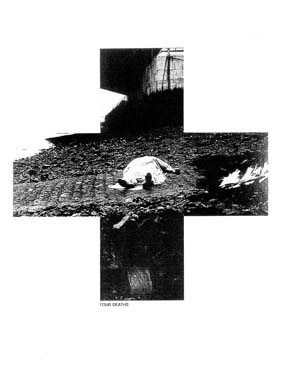
            Another good example of how text can influence how an image is perceived is artist John Hilliard. His photographs are actually fiction, but what he does do is takes a series of photographs of the same thing, but change where the frame is places on the image, so as he can change what the image can be perceived as, even though it is the same photograph repeated. But to engage the viewers imagination and mind, on each frame he has 1 word of type, which explains the cause of death, for instance in the picture ‘Cause of Death’ taken in 1970, he took a picture of a figure lying on a stony beach with a white sheet thrown across it. And so through changing the frame he changed he ‘cause of death’, from drowned, where he has the sea in shot, fell, to where he had a building in the background in shot, burned, with a fire in shot, and crushed, with rocks in front in shot.
 The image before it was cut
The Image after it was cut

Thursday, 17 November 2011

Lecture 8, ITAP - Production for Visual Communication


When we talk about production, it is not instant that we think of visual production, but with some thought, a lot of production is visual communication. We’ve been visually communicating through out the whole of time, even through wet clay markings in 2000 BC. We advanced to pictures for instances the earliest recorded history were the pictures of Babalon from around 3300 BC. Moving on to 400 AD, the world’s oldest dated book is recorded on silk, called ‘The Diamond Sutra”. The first printed book in America was ‘The Whole Book of Psalms’ printed in 1664. But the history of the printing of books is rich in history well before is reached the United States. The first printed book in Europe was printed by Johannes Gutenberg, in Mainz, Germany in the 1450s, it was called the Gutenberg Bible and was printed with a movable type printing press. It was printed in black letter type style that was later to be known as Texualis and Schwabacher, which was printed by an oil-based ink that would adhere to his metal type. The ink was mainly carbon but also had high metallic content with lead, titanium and copper predominating. Although William Caxton was the person to introduce this art, the printing press, into England after the Dutch, German and French. He set up a press in Westminster in 1476 and the first book to be published there was an edition of Chaucer’s Canterbury Tales. He was also the first person to print a book in English.


If you try and think about the 10 key developments which helped in the production of graphics to how it got here today, there’s a lot to think about. What counts as a milestone rather than just a development what makes history to how we conjure and manipulate images today, what production of technology makes graphics what it is? Well, looking through from 3500 BC through to 2008, there’s a lot that has gone on, I have chosen 10 key milestones which I feel have truly benefitted and changed how we do graphics in the current day. The first milestone is from 3200 BC when Sumerians use cuneiform alphabet on clay tablets, this is important because this first introduces language and communication into the world, how to talk/communicate to one and other. In 105 AD paper was invented in China by Ts’ai Lun, without paper we would be without resource that was accessible and easy to use, and today without paper, we would not be at the visual communication stage we are at now, without paper, how do we have portable communication? In 445 Johannes Gutenberg printed the first book in Europe, without the invention of printing we could not replicate and communicate the same thing several times without having to draw/write it over and over. Without printing we wouldn’t be able to communicate efficiently and productively. In 1790, Thomas Bewick perfected the process of wood engraving, without wood engraving we would never be able to get the exact replica over and over again for an image. In 1875 Offset lithography was used for printing on tin, without other forms of printing we wouldn’t be able to print onto other malleable surfaces, tin is much more hard warring that paper to therefore lasts longer, meaning a message/communication can last longer. In 1887 Monotype machine was invented by Tolbert-Lanston, which was more versatile that linotype. It was used for commercial printing, it produces individual characters to print and can switch between fonts also special symbols were easily incorporated such as math’s equations. Without the monotype machine we would not be able to print complicated communication and changing types, which are a big part of graphic communication. In 1948 the colour scanner was invented by Kodak and was a revelation for graphics, this now meant that things could be scanned into the computer and manipulated in a different way. In 1987 Apple Macintosh launched its first computer, and without computers we would not have Adobe Illustrator which was invented in 1987 which dramatically changed the way images could be views, images could now be drawn and manipulated in a completely new way that the human hand could not do before. And this was all made possible and to be views by the world through the invention of the World Wide Web (WWW) introduced in 1992 by Tim Berners-Lee of CERN. Without the web we would not be able to broadcast work and communicate to people, clients, supporters and buyers of graphics without computers and the internet. It changed how graphics worked and how it was scene to become a global market accessible to everyone.

Tuesday, 15 November 2011

Lecture 7, ITAP - Idea and Structure in moving image


All story development can be link to the pinnacle 3 act structure, Jean-Luc Godard (a film maker) famously said that: “Every movie needs a beginning, middle and end. But not necessarily in that order.” When looking move thoroughly there is an establishment, a crisis and a resolution, where characters start in equilibrium, something then stirs it/crisis and then all parts become out of balance, and then as to resolve a new equilibrium is formed. When looking into the structure of films there are many different genres to follow, a recent film that I watched and which I am going to base the 3 act structure around is ‘In Time’ directed and written by Andrew Niccol. In Time has the classic 3 act structure, the establishment of the setting, time and storyline are the first things to be laid out. It starts will Will Salas, the main character, explaining the world he lives in, where people are genetically engineered to live to 25 and then a year after that to gain more time, the currency is now time, and people have to work to live. We see that he is from ‘the ghetto’ aka. Dayton, which is a very poor, no time district. Will meets a man who has a century on his watch and saves him from thugs at a bar. When they run to an empty warehouse and fall asleep, this is when the first change happens, the 105 year old man, Henry Hamilton gives all his time to Will and commits suicide himself by ‘timing out’. It is then that Wills mother also ‘times out’ on her way back from working and dies in Wills arms. This is the crisis. It is then that Will decides he will travel to the top of the time districts to New Grenwich – where time equals immortality to the rich. Although the ‘time keepers’ are on to Will thinking he has murdered Henry and they catch up to him in the richest man in the worlds house Philippe Weis, where he captures his beautiful daughter Sylvia Weis and goes on the run. Between them and the running they become closer, and this is where the romantic encounter appears, causing Will and Sylvia to work together against her father, whilst running away from the time keepers and the thugs of Dayton to overcome the hardship and the stolen time, giving the poor a chance to live, this is where the resolution occurs. Will and Sylvia over power her father my stealing his 1 million time clock in his safe, therefore over turning the currency of time, giving people more time to live. So to end the film, the good has conquered the evil, partly, and it is left with Will and Sylvia about to steal more time. 


Every aspect of a character is designed to communicate with the audience so as they fulfill their role and are appealing to the audience to watch. When looking at the third series of FRIENDS I looked into the second episode called: “The One Where No One is Ready”. Ross was the main character for this episode, so I decided to look into his character and how he is depicted and carries out his role. The episode is based around the fact that no one is ready for Ross’ museum benefit event where he will be making a speech. So it opens when Ross walks into Monica and Rachel’s flat, dressed in a tux, with slick gelled hair, shaven and neat, from this you can tell that they are suppose to be dressing for a smart event and that it is very important to Ross by the way he has presented himself. Ross walks in to find no one else is ready and is exact by the minute of how many minutes they have to get ready, he is also twitchy and nervous which Joey points out because he is doing a speech. Ross then has to reason between Joey and Chandlers argument over who should sit in the chair and starts to become nagging and angry. Rachel then comes out not dressed and Ross hurry’s her back into her bedroom because he needs her to be dressed. Phoebe arrives, the one person Ross is happy with because she Is dressed as “is his star”. Monica arrives home and listened to her answer machine messages and has a message from Richard, her ex, sending her into a fit of paranoia and longing, so she doesn’t get dressed, you can tell that now that Ross is getting anxious and egger for everyone to hurry up. Joey and Chandler are still arguing over the chair and flick humus at the dressed and ready Phoebe making Ross repetitive and apprehensive because now no one is ready. It starts to rain which makes Ross angry because it’ll be harder to get a cab. He then goes to pick an outfit out for Rachel because she STILL isn’t dressed and picks a Halloween costume, so she is still not dressed. Joey then walks in asking Chandler where his pants have gone and Ross has to intervene to get Joey to go back and get dressed, by this point Ross looks exasperated and slightly sweaty as if worried and stressed. He then checks the time as he has been counting down the minutes till they have to leave and his watch has stopped working, which then makes him even move agitated. Rachel then comes out comparing shoes and Ross shouts at her for taking to long and that she should wear anything. He then tries to get Monica off the phone but she pinches him, depicting that they have had this retaliation since childhood and that they are brother and sister, but gets her to go and get changed again. Rachel then comes out of her room, undressed, but now in pajamas because Ross humiliated her by shouting at her in front of everyone, Ross and Rachel have a conversation, Ross is trying to get her to understand that he still has to go, and tries to give her a kiss but she turns away. This body language shows that Ross and Rachel are together but she is unhappy about the way he treated her so is retaliating. Joey then appears with all of Chandlers clothes on as revenge and Ross is at breaking point and he tells them off, because all he wants is for Rachel to go, who he then apologizes to, to try and seek forgiveness and asks what he can do to prove it to her. Joey suggests drinking the cup of fat and Rachel agrees that that was a good idea. Ross goes to drink it, because he wants to prove to Rachel and she stops him and forgives him. Ross then goes back to commanding everybody to get ready and runs down stairs to get a taxi. Ross then comes back upstairs with 2 taxi’s waiting, now looking happier and relieved because everyone is ready and they’re going to leave on time and Rachel looks so amazing he now wants to be late, but she drags him out the door after all the fuss.

            It is important in character building that the character’s movements and speech reflect their tone of voice and mood and what their personality is like as a character. For instance with Ross he is punctual, twitchy, intelligent, precise, caring, sensitive, brotherly annoying, cares about his appearance, loves his job and what he does, is always right and has his funny moments, which I think is in keeping within “The One Where No One is Ready”.